The Joy of Discovery
30/07/26 20:31
 July 31, 2026 (Vol. 20 No. 28) —In my role as a journalist and a college professor, I have had the privilege of researching and writing history. Reporting is often called the first draft of history. It is usually accurate - assuming you are not watching Fox News or reading the New York Daily News. But spot reporting often lacks the depth of analysis one can only achieve with the emergence of information that comes with the passage of time. It is only when historians, often but not always academics, have the opportunity to do a deep dive into documents and artifacts, that we get a complete understanding of what happened and why. Of course, historians often have differing opinions, but at least the ones worth listening to are based on empirical evidence.
Although I have retired, I still consider myself a journalist and historian. In the five and one-half years since I stepped away from the University of Kansas faculty, I have remained an active writer. I have written two books of historical fiction, one about the causes and effects of school shootings and the other about growing up in the turbulent 1960s. Although the storylines are products of my furtile imagination, they are based on a solid background of historical research. Prior to my retirement, I also coauthored several textbooks and guidebooks, plus one sole-authored nonfiction. I am now in the process of researching a new nonfiction book, one that requires an even deeper dive into the subject matter, in this case the Second World War. The very best kind of research is that drawn upon original sources such as interviews, historical documents and artifacts.
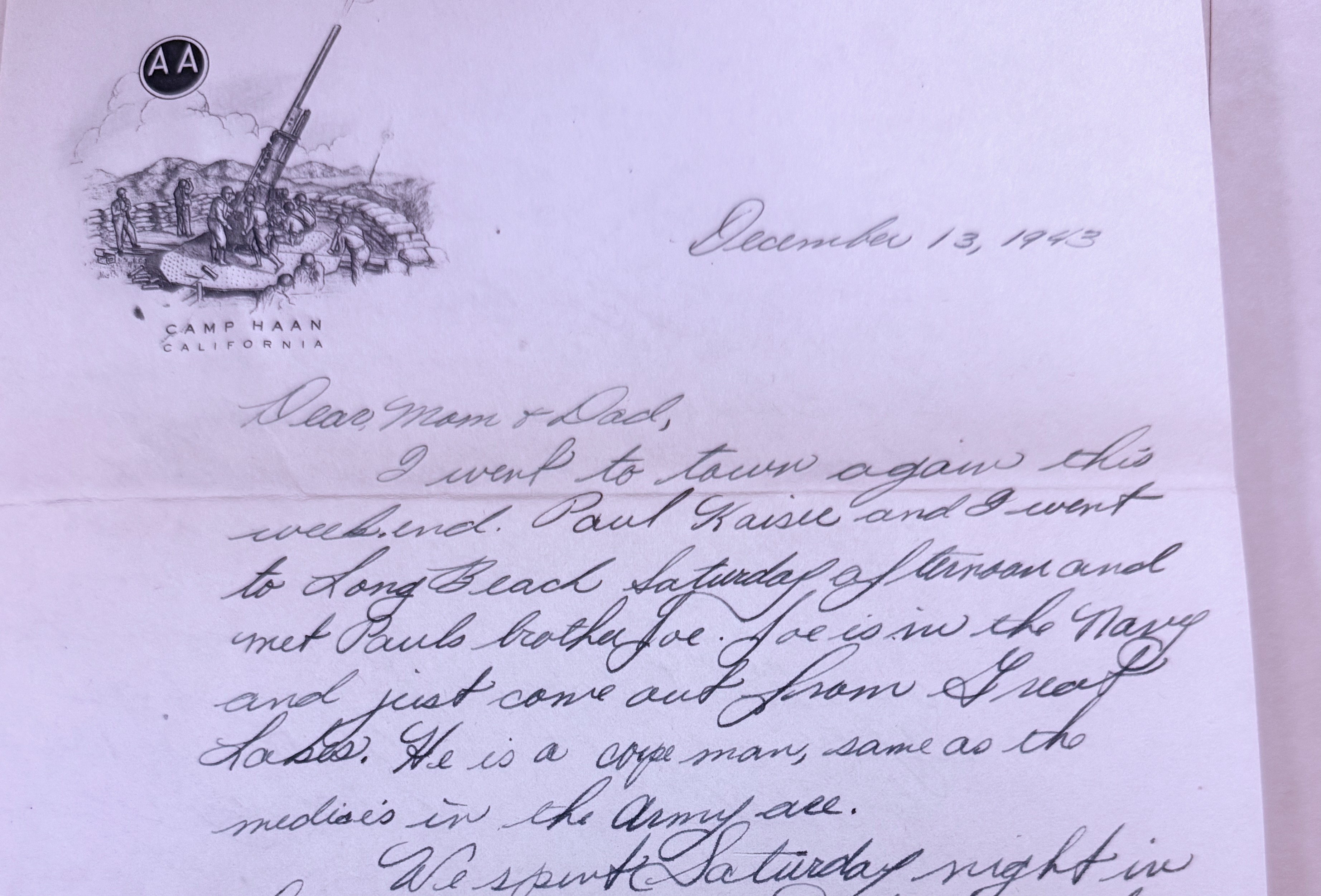
Pictured above is an example of both a historical document and an artifact. It is a letter home from a G.I. serving during the war. It is one of more than 500 letters he wrote during his time in the service and subsequently donated to the University of Kansas Archives. I am just about one-third of the way through the letters and they are telling me quite a story about a 19-year-old Kansas kid growing up to be a man before our very eyes. These are just some of the original source materials I plan to review prior to actually writing my manuscript. It is tedious and time consuming - and I love it.
At the risk of sounding "nerdy" or "eggheadish," I enjoy archival research. It brings with it a certain joy of discovery. Once, while doing research in the Dwight D. Eisenhower Presidential Library, I discovered that Ike liked to doodle during official meetings. At this one particular Cabinet meeting, a bored President drew a cowboy, horse and cactus on his agenda memorandum, a document preserved in the Eisenhower Archives. Of course, I got more out of that session than a presidential doodle. My time in the archives provided me the material for several publications and presentations which significantly aided me in achieving promotion and tenure at the university. While researching a journal article about newspaper coverage of the 1952 opening of the Chesapeake Bay Bridge at the Maryland State archives in Annapolis, I ran across an academic paper written by my grandfather while at Johns Hopkins University in 1900. I also based a journal article about the birth of what would become the United States Information Agency plowing through documents at the Harry S. Truman Presidential Library.
I believe archival research is akin to putting together a 3D jigsaw puzzle. By examining a particular event through the differing perspectives of multiple actors, one achieves a more thorough understanding of what happened and why it happened. During this process, you are not only reading about history, but you are literally discovering history. And once that discovery is committed to paper, you are forever connected to it. I can't tell you how thrilled I was to hear one of my journal articles cited during a CSPAN discussion of the Eisenhower presidency. There's a lot of satisfaction in being described as a presidential historian.
All too often, there are those outside of academia, especially legislators, who do not understand the importance of social science research. They often underestimate the impact of these efforts, not realizing the important roll it plays in understanding the past and molding future policy decisions. And for a retiree like me, continuing my role as a researcher and writer provides me with both an identity and purpose I can carry with me until I draw my last breath. That's it for now. Fear the Turtle.