October 2025
Adventures in Writing: A Sentimental Journey
30/10/25 07:45
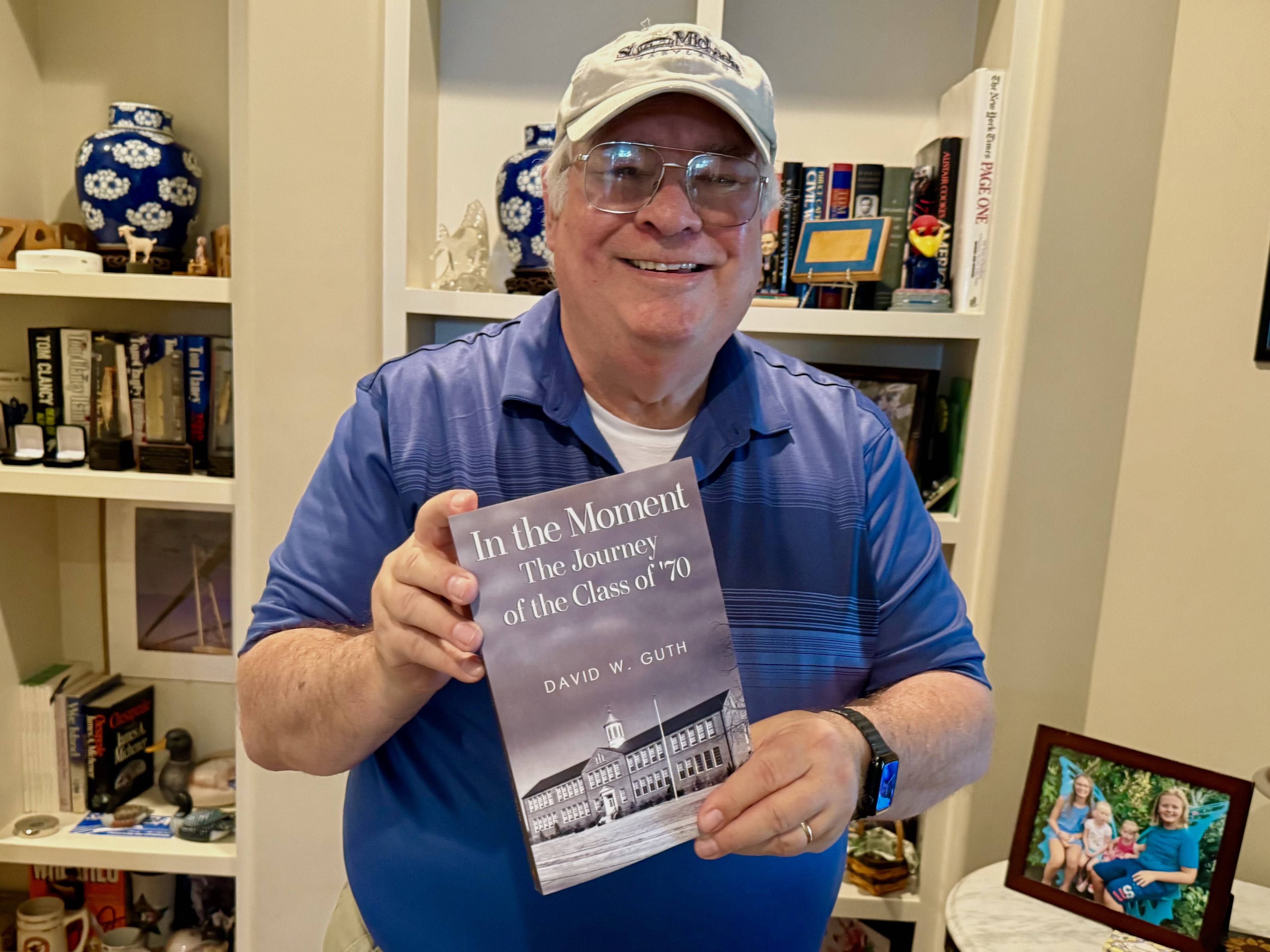 October 30, 2025 (Vol. 19 No. 42) - My latest book, In the Moment: The Journey of the Class of '70, is an attempt by me to straddle the worlds of fact and fiction, reality and fantasy, and reflection and projection. I’ve always wanted to write about the time and place where I was raised. And this book clearly shows my bias toward and love of the Delmarva Peninsula.
Some may find it hard to believe, but Maryland’s Eastern Shore was a very interesting and exciting place in the 1960s. It was a battleground over civil rights and school desegregation. It also saw many a politician glad-handing “the locals” from the Kennedy brothers to Spiro Agnew to George Wallace. It was also an area undergoing great social and environmental change, largely due to the influx of new residents lured by the Chesapeake Bay Bridge. Places such as St. Michaels and Easton were being transformed from sleepy towns that only a few seemed to treasure to the tawny tourist destinations they are today.
I chose to write about these and other issues from the perspective of my own cohort, school kids who graduated high school in June 1970. I also used as my setting the town where I attended my first eight years of school, St. Michaels. But here is where fact versus fiction straddling comes into play. I wrote historical fiction, meaning that most of the local, national and world events mentioned are true. Even some of the family names used in telling my story are ones common to the Eastern Shore. But the characters and their actions, for the most part, are fictional. Even those events based on my personal experience have been fictionalized to improve the plot line. An example of this is my description of the classroom reactions to the Kennedy assassination. But everything else is a product of my imagination. My goal was to tell a story about those times. I left it up to my classmates to tell their own stories. (One of them, my life-long friend Klaus Liebig, has, in fact, done so in a book entitled The Things I Remember.)
So, what’s next? I have no earthy idea. I’d like to get a sense of how well my latest book is faring before launching into another two-year project. While I have a good few ideas for the topic of my next book, none of them have yet ignited my passion for another literary adventure. I will also turn 73 within a couple of weeks. My health will also be a determining factor in my decision to continue my literary career.
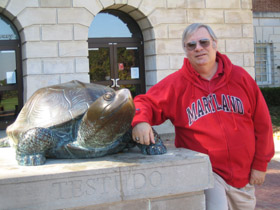
This series of posts about my writing began innocently in May when I wrote about the publication of In the Moment. It made me ask the big question: Why do I write? Upon reflection, I think I know the answer: I love telling stories and I know how to do it. That's one of the reasons I became a journalist. If you look in the lower right corner of the picture above, you'll see my grandchildren. In a sense, these books are for them, as well. I’ll admit there may be some ego involved, but exposing one’s thoughts to others can prove to be a double-edged sword. The readers may love you or hate you. The writer must have enough confidence in himself or herself to gracefully handle either outcome. That's it for now. Fear the Turtle.
No Kings, No Sh*t
19/10/25 10:30
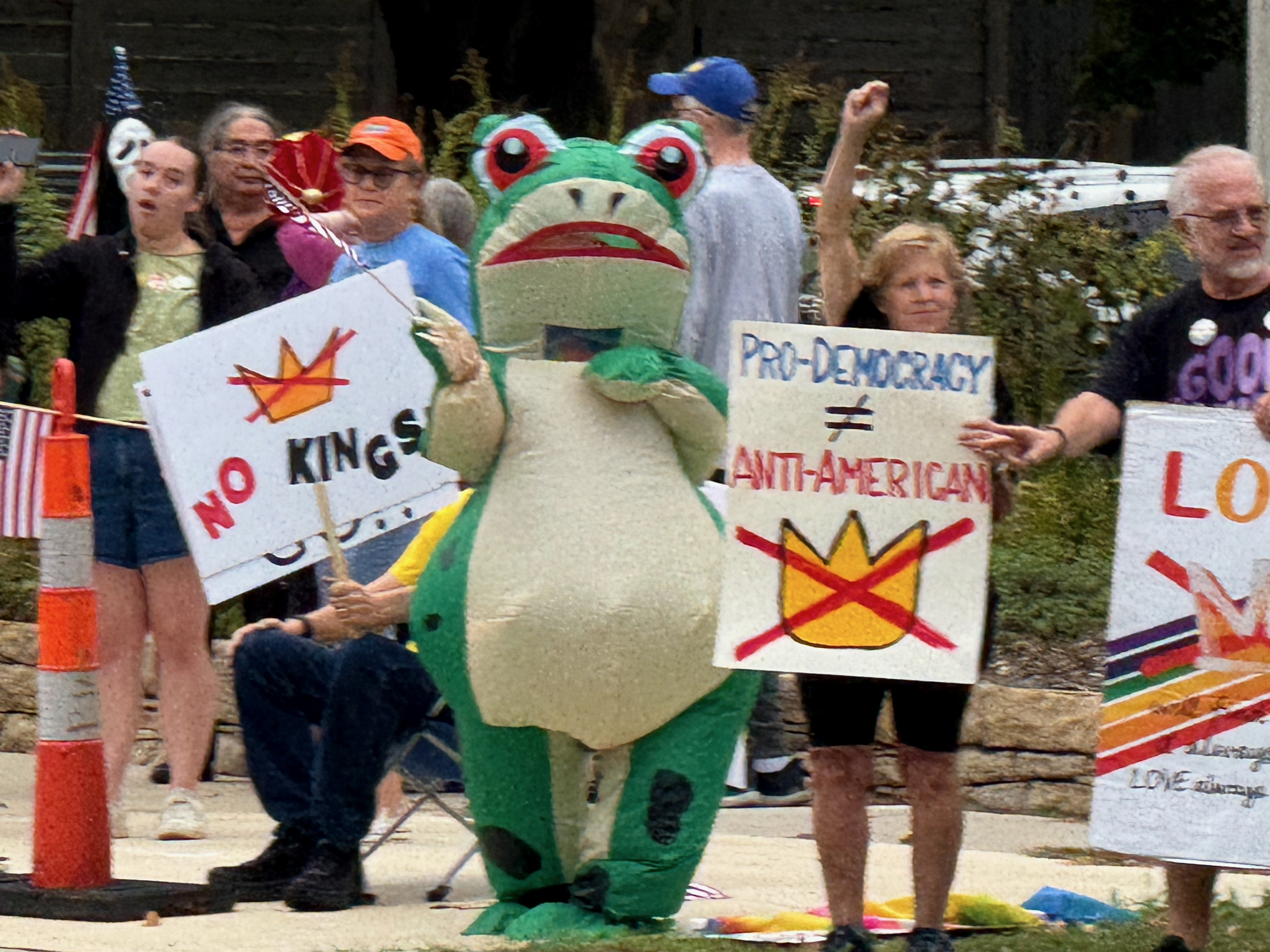 October 18, 2025 (Vol. 19 No. 41) - While millions of Americans took to the streets yesterday in protest of the Trump Administration's increasingly authoritarian approach to governing, the President of the United States used a crude and disgusting A-I generated video to literally crap upon the American people.
 In more than 2,600 communities throughout the nation and including some overseas as well, millions of people exercised their free speech rights to express their opposition to an administration that has used masked agents to detain persons of color they believe may be in the United States illegally. Often they are indiscriminately arresting American citizens and people who are properly documented to be in the United States. These protesters object of the weaponization of the Justice Department in vengeful pursuit of Trump's perceived enemies. They are angry about the dismantling of federal safety net programs at the expense of the poor to pay for tax breaks for Trump's ultra-rich friends. Trump's tariffs have already negatively impacted America's farmers by driving China's soybean import market from the United States to Argentina. Speaking of Argentina, why is Trump endorsing a $20-40 billion bailout of Argentina's flailing economy while gutting healthcare, public safety, education and safety net programs for everyday Americans? Let's not forget the immorally pliant Republican Congress that has shutdown the government to avoid any compromise with Democrats - and in an attempt to avoid the inevitable release of the Epstein files. (Based on what we already know about Trump's attraction to young, underage girls, does anyone doubt that Trump is a sexual pervert?) It looks like Trump is again cozying up to Vladimir Putin at the expense of Ukraine. (Could it be because of the pee-pee tape?) Trump turned a blind eye to Israel's genocide in Gaza, only now to claim he deserves the Nobel Peace Prize. And what's with giving Qatar an airbase in Idaho? (It likely has more to do with Trump's personal business interests than with national security.)
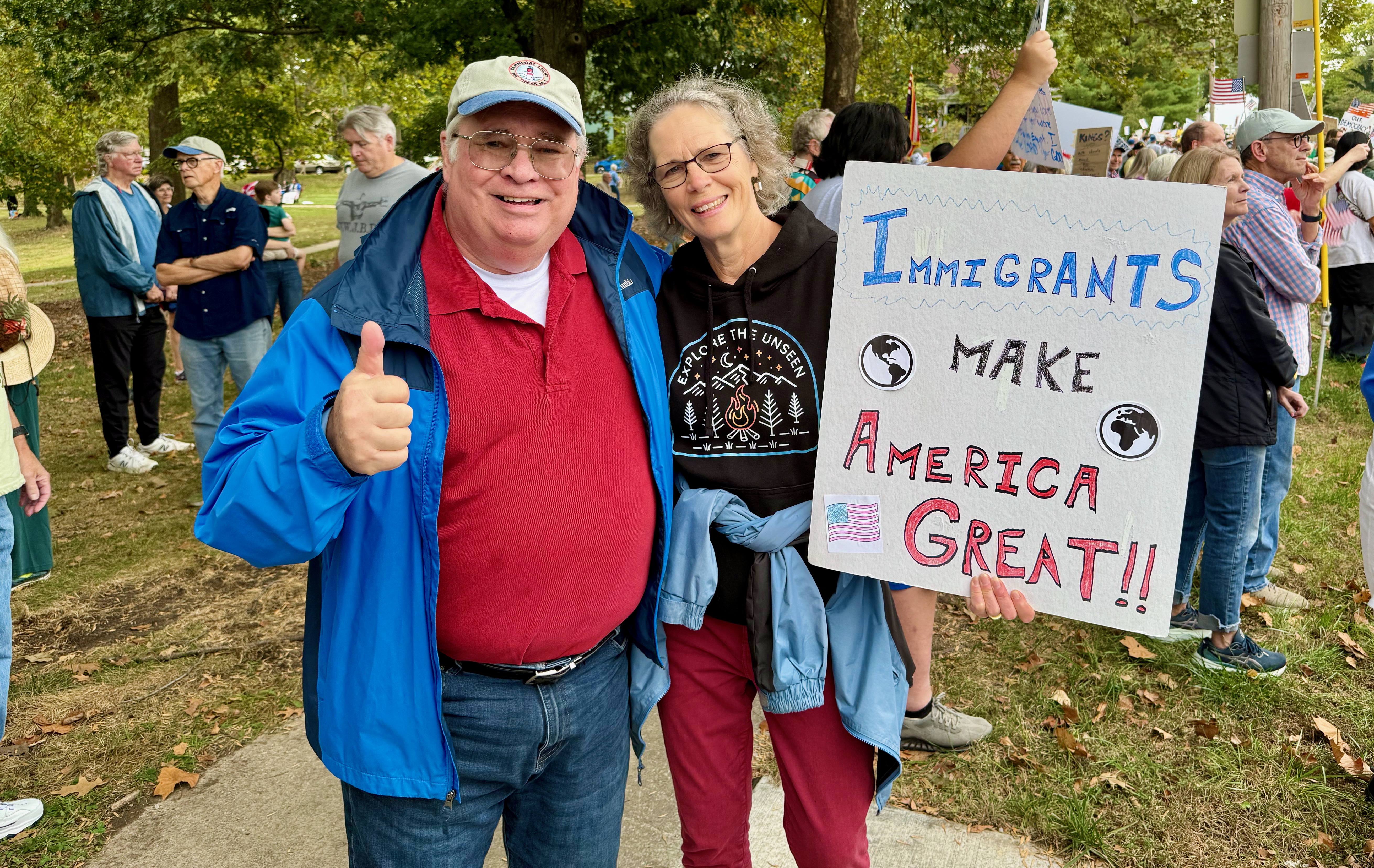 Those are just some of the reasons that millions of Americans - including myself (above) - were compelled to raise their voices and say "enough is enough." Here in Lawrence, Kansas, approximately 1,000-2,000 people gathered in a downtown park in a non-violent, albeit noisy protest. To put those numbers in context, they are significantly higher than those during last June's nationwide Trump birthday protests. Based on the pictures I have seen from other cities, that sharp increase is indicative of a growing and engaged national opposition to Trump and his party of sycophants. Yesterday's protests should give every Republican pause. Surely some of them are wondering just how long they can afford to ride that one-trick pony. Even with their attempt to redraw congressional district maps to rig next year's midterm elections, the Republicans may well lose both the House and the Senate.
And how did the President of the United States, the erstwhile leader of the Free World, react to yesterday's protests? After yet another round of taxpayer subsidized golf, he posted an A-I generated video of him as a pilot in a fighter jet. He was wearing a crown. As the plane swooped over protesters in a city that looked a lot like New York, he unleashed a bomb load of a brown liquid substance upon the crowd. It takes no imagination as to what that disgusting substance was. Metaphorically, King Donald was joyfully taking a dump upon the people he is supposed to serve.
Yesterday's protests were huge. And they are only going to get bigger as Trump's policies hurt more and more people - especially those who voted for him. The die is cast. Against Trump's wishes, the tide of democracy is rising. Eventually, it will cover everything, including Donald Trump's crown. That's it for now. Fear the Turtle.
Adventures in Writing - A Touchy Subject
15/10/25 15:43
 October 15, 2025 (Vol. 19 No. 40) - Sometimes a writer's passion takes him or her to a place others may wish they did not go. That was the case with my first fiction novel, Thirteen Minutes: Death of an American High School. As the name suggests, it is a story about a school shooting at a fictional high school. I characterize Thirteen Minutes as a contemporary fiction that blends a fictional story with the real-life facts about the causes and effects of school shootings.
 I am a passionate gun control advocate. I am not a left-wing, "take away your Second Amendment rights" kind of guy. I happen to believe that the Second Amendment and reasonable regulation of firearms, ammunition and gun magazines can peacefully coexist. Unfortunately, those who disagree with me often doing so by expressing their anger - including the occasional death threat. Needless to say, this was not an easy topic to write about. When it came to the matter of gun violence in America, I made certain that my narrative was supported by verifiable research. I also tried to avoid a gun control slant in the story. As was the case in real life, some of the characters were strongly in favor of gun control while others were equally strongly opposed. I laid out their arguments and left it to the readers to form their own opinions.
However, that was hardly the biggest challenge in writing Thirteen Minutes. I quickly discovered that writing fiction is, in many ways, harder than writing nonfiction. When I wrote my first novel, Bridging the Chesapeake: A 'Fool Idea' That Unified Maryland, I was dealing with a known set of historical facts. In Thirteen Minutes, the entire plot was a creation of my own imagination. I had to keep track of the characters and their actions. Because mine was a story with a few twists and turns, it was easy to become confused with who did what to whom. For example, in my third edit of the manuscript, I realized that I had one of the main characters killing himself - which, of course, would have confused the heck out of the readers. To avoid that kind of confusion, I had several pages of notes reminding me who the characters were, what their jobs/roles were and what was motivating them to do what they did in the story. I'm not sure that is what successful fiction writers do, but it sure helped me.
Honestly, Thirteen Minutes is my least succesfull book in terms of its sales. (If you'd like to help me in that regard by buying it, I'd very much appreciate that!) However, I believe it may be my most important book because it shines a light on a tragically singular American issue. I also think it is good, albeit dark, story. Of course, as all authors know and must accept, that's for others to judge. That's it for now. Fear the Turtle.
Adventures in Writing - The Bridge
09/10/25 10:29
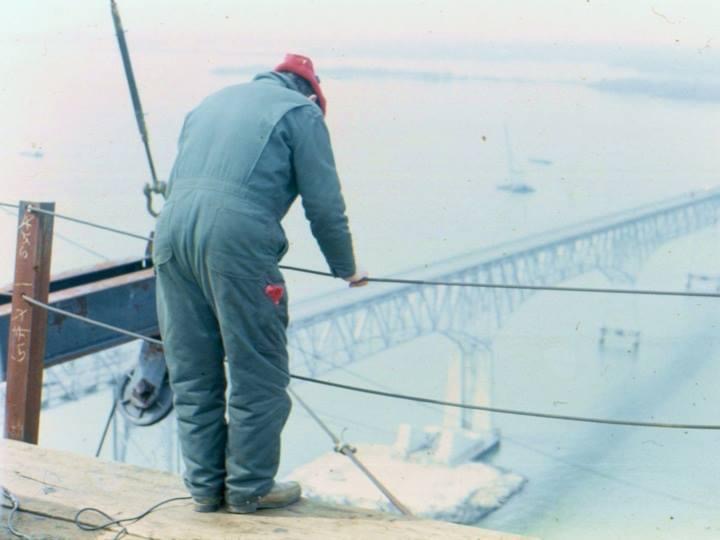 October 9, 2025 (Vol. 19 No. 39) - The idea for my first solo-authored book was conceived in the Italian village of Paderno del Grappa in the spring of 2004. I was privileged to be teaching two journalism courses at Consortium International University during that semester. During those memorable four months, I was relieved of the normal research and service obligations of a tenured professor. Instead, I had time to ponder how I might move forward into the remaining 10-20 years of my academic career.
 Perhaps over a glass or two of limoncello on a balcony overlooking the Italian Veneto, I came to the realization that I would be best-served and most-happy if I pursued projects for which I was passionate. That may sound like a no-brainer, but it was really an epiphany for me. Up until that time of my life, I was pretty much saddled with what I have to do. But now, a tenured professor and with my daughter off to college, I realized that I could do what I want to do. So, the central challenge during those soft Italian nights was to identify what I was most passionate about.
To the surprise of everyone I know, I decided that I wanted to write a book about the construction of the Chesapeake Bay Bridge. "Really. A book about a bridge?" was the general reaction. I understood their befuddlement. Unless you had grown up on Maryland's Eastern Shore, the political, social, historic and psychological significance of the structure alluded you. The 4.3 mile span made access to what had been the remote Delmarva Peninsula available to all. It removed the final barrier that had severely inhibited interaction between the peoples of the two shores from the days the Maryland colony was founded three centuries earlier. (The above picture is one I took during construction of the bridge's parallel span in 1972.)
Based on a content analysis I conducted of Bay Bridge coverage of eight Maryland-area newspapers in 1947 (when the bridge received legislative approval) and 1952 (when the bridge opened to traffic), I determined that the span symbolized different things for different people. To generalize those findings, I determined that the people on the Western Shore saw the new bridge as a good thing, while the folks on the Eastern Shore saw it as a threat to their way of life. A historical review also revealed a fascinating story of the competition between the two shores and the long, difficult journey toward construction of the span. There were heroes and villains. There was also the amazing sweep of American history that influenced this saga from conception to completion. In short, it was a great story. Why wouldn't I write about it?
Bridging the Chesapeake: A 'Fool Idea' That Unified Maryland was first published in 2013 by Old Line Publishing. When that publisher went out of business, the book was republished under the Archway Publishing banner in 2017. I feel the publication of this definitive history of the Bay Bridge - now known as the Willian Preston Lane, Jr. Memorial Bridge - is one of the greatest achievements of my professional career. I believe it established my credentials as a thoughtful contemporary historian. Frankly, there are few titles one can own that brings more satisfaction than being called "an author." It fueled a passion to write that continues to this very day. That's it for now. Fear the Turtle.
The Performative Presidency
04/10/25 12:42
 October 4, 2025 (Vol. 19 No. 38) - John F. Kennedy is considered to be the first television president - although one can argue that his predecessor, Dwight D. Eisenhower, was the first to really embrace what was then a relatively new medium. One can also argue that no president benefitted as much from the medium as the current occupant of the White House. Donald Trump’s appearance on The Apprentice softened the edges of the Manhattan vulgarian and helped propel him to the presidency.
The key is understanding Donald Trump is knowing that he’s not so much interested in governing as he is in being seen as a strong leader on television. To put it another way, he doesn’t want to be president as much as he wants to be seen as president on TV. And because he is media savvy, Trump has also embraced social media at a much higher level than any of his predecessors. One could call it the “Twitter Presidency” if Elon Musk hadn’t changed its name and ruined the platform. So Trump invented his own form of Twitter, Truth Social. (Ironically, his posts on that platform are neither truthful nor sociable.)
It is more appropriate to think of this cacophony of chaos as a Performative Presidency. It’s all about the performance. He announces new policies and initiatives on Truth Social and in his encounters with journalists. As for the details, he lets someone else figure that out. An example was yesterday’s big Gaza announcement. Trump said the Israeli hostages will be freed, but admitted that those details have yet to be worked out. One would think that when it comes to the Middle East, you’d want to have all of the ducks in a row before making promises you may not be able to fulfill. That’s also why he will say some bombastic and often obscene things for the cameras. Felon 47 thinks it makes him look strong and invincible. Trump doesn’t understand when his words do not match his actions, it exposes him for the weak wimp that he really is. That’s why some may call this the TACO Presidency, as in “Trump Always Chickens Out.”
To Trump, leadership is a performative art. And there’s some truth to that. Leadership requires clear, unambiguous and motivational language. Solid communication is the key. Dwight Eisenhower, who I consider one of this nation’s greatest leaders, understood this. Both as Supreme Allied Commander during the Second World War and later as the 34th President, Ike understood the value of unambiguous and quiet leadership. Historian Fred Greenstein has referred to Eisenhower’s two terms in the White House as The Hidden Hand Presidency. Much of what Ike did - and he did a lot more than most presidents - was out of the sight of reporters. In so many ways, Ike is the antithesis of President Bone Spur. Ike rarely raised his voice. Trump’s knob is stuck at full volume.
The danger, of course, is that while Trump doesn’t pay attention to the details, his evil minions like Steven Miller, Pete Hegseth, Pam Bondi, Russ. Vought, and Robert F. Kennedy, Jr. do. These unelected ideologues are shaping - some would say they are dismantling - the federal government without regard to congressional oversight or the laws of the land. As Trump gets older, more feeble and fragile and his dementia (and incontinence) accelerates, the peril for American Democracy increases.
Barring his death, resignation or impeachment, we are stuck with three more years of Trump’s Performative Presidency. However, if Democrats can get their act together, they can seize both the House and the Senate in next year’s midterm elections. That, in turn, will have the effect of neutering an already impotent president. That's it for now. Fear the Turtle.