See Roger Run
03/10/26 01:42
 October 3, 2026 (Vol.20 No. 36) - The junior U.S. Senator from the state of Kansas is in a heap of trouble. After serving as Donald Trump's lapdog for the past six years, he now finds himself in a fight for his political life and, like a lot of other Trump toadies this fall, he is losing.
Quack Marshall has more luggage than your typical Samsonite store. First, there's the question of his residency. He'd have you believe that he lives in a small, three-bedroom cabin near St. John in south-central Kansas. But there's a paper trail that suggests his $1.2 million Sarasota, Florida, home is where he spends most of his time. And the more he denies it, the less credible he becomes. Then there's the question of his support for Trump's Big Beautiful Bill, which has had a devastating impact on Kansans. It's hard to tout tax relief for billionaires while cutting SNAP benefits and healthcare for thousands of his constituents. Then there is Marshall's support for Trump's costly and mismanaged war against Iran. On several occasions, Marshall could have been the deciding vote to force Trump to follow the War Powers Act. Instead, he has blindly followed Trump, Hegseth & Company down an inflationary rabbit hole with no end in sight. And one should never forget that Marshall's first act as a U.S. Senator was to try to overturn the election of Joe Biden as president. Of course, the biggest albatross around Quack Marshall's neck is Donald Trump, who is historically unpopular. Trump wants this election to be a referendum on his presidency. Democrats could not agree more.
But there's more. Roger the Dodger - he's avoided town halls with his constituents for the past 19 months - has come under scrutiny for his business practices as a doctor. He's been suing his patients for past-due bills and having some arrested while charging exorbitant interest rates. All of this is going on as he has repeatedly voted against expanding Medicare for Kansans in need. No, this guy ain't no Dr. Marcus Welby. He's also noted for having a bad temper. He used his influence to get out of a legal jam prior to joining the Senate. He also famously told voters hurt by the war-driven rapid rise of gas and diesel prices to suck it up. In short, Roger Marshall is not a very nice man.
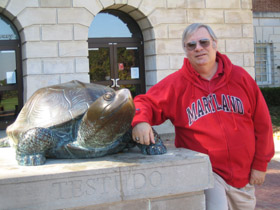
Contrast and compare Marshall with his opponent, Adam Hamilton, who most pundits say has a real shot of winning Marshall's seat for the Democrats. By all accounts, Hamilton, pastor of the largest Methodist congregation in the country, is a nice and compassionate man. He is also one who says he is willing to reach across the aisle and work with Republicans to solve problems important to Kansans. Hamilton dominated Marshall during their recent debate at the Kansas State Fair. After running away from his Democrat challenger, Marshall is now open to a second debate on live television October 21. That and the knowledge that the Republicans have decided to start pouring millions of dollars into the Kansas senate race is a sure sign that Quack Marshall, politically speaking, may soon be a dead duck. That's it for now. Fear the Turtle.
It's YOUR fight, too!
24/09/26 07:24
 September 24, 2026 (Vol.20 No. 35) - It was predictable. A federal judge reaffirmed the right of a free press to cover the President of the United States early today. Judge Timothy Kelly ordered the President to reinstate CNN’s, MS NOW’s and Politico’s access to the White House. In his order, Judge Kelly wrote the that the President’s abrupt ban last week of these three media outlets was done without “constitutionally adequate due process.”
As we have seen this week, the President’s media tizzy-fit backfired. When these three media outlets were banned from the press room, other news organizations - including Fox News - refused to participate in the White House press pool. That denied Donald Trump access to the position he most cherishes, being in front of cameras. Since Judge Kelly’s rule was a temporary restraining order, it will be interesting to see whether the Trump White House wants to push this matter farther. Not only would he be likely to lose on appeal, but the move would be just one more false step that will hurt Republicans in the midterm elections. I’m sure beleaguered Republican candidates wish he would quit while he is “ahead.”
Thanks for reading David’s Substack! Subscribe for free to receive new posts and support my work.
I know that many Americans are viewing this media-government tussle with some amusement. But this is not someone else’s fight. It is your fight, too. A healthy democracy cannot operate without a free and unfettered press. You have a right to know what the government is doing in your name. That right is enshrined in the First Amendment of the Constitution. Anything that weakens the First Amendment of some weakens it for all.
We have already seen this Administration treat the Constitution as a doormat. The President has engaged in an unconstitutional war against Iran without Congressional approval. He had made tremendous budgetary commitments for his vanity projects in Washington without congressional approval. He has enriched himself by $2 billion in violation of the Constitution’s emoluments clause. Let’s not forget that the bastard engaged in sedition by trying to overthrow the 2020 election by sending a mob to the Capitol on January 6, 2021. God knows what he is planning to overturn what is expected to be a resounding rebuke at the hands of voters this November. He’s already promised $5,000 to every American should the GOP win - an idea that is not only ludicrous and inflationary. It is also illegal. And speaking of illegal, our President - in your name - announced to the United Nations that he is pondering the commission of war crimes by committing genocide in Iran.
And you wouldn't know about any of this without a free press acting as a check and balance against this tyranny.
This is your fight. And you have the ability to let the White House and his synchophantic Republican minions know that you do not approval of this oligarchical approach to governance. Vote blue this November as if your life depends on it. Because it does. That's it for now. Fear the Turtle.
Mini-Mike Takes A Hike
16/09/26 20:49
 September 16, 2026 (Vol.20 No. 34) - The next time you see a Republican member of the U.S. House of Representatives, ask him or her this question: Why don't you like your job? When he or she tells you that they love their job, ask why the House will have been in session only 46 of the 163 days between Memorial Day and Election Day? That's only 17.5 percent of the time. Sure, in a democracy our elected officials need to stay in touch with the voters. But you would think that House members should spend at least a little more time actually legislating and addressing the issues that affect their voters most. Right now, for example, voters are waiting for the House to deal with a panoply of issues including the high cost of living, Trump's undeclared and largely unsuccessful war, the need for safeguards in the development of artificial intelligence, the broken promise of Epstein files transparency, and the recurrence of diseases such as measles that we previously thought of as eradicated. These issues will continue to gather dust until after the midterm election because the Speaker of the House, Mini-Mike Johnson, has sent them home. He says that will give the Republican members time to tell voters what a great job they are doing.
Uh huh. But the problem with that logic is that in poll after poll after poll, the people are not buying it. According to an average of all polls, Democrats are leading Republicans by 7.5 percentage points in the generic congressional ballot. That is a significant gap. And I don't believe that all of the lies and innuendos the Republicans can spew forth during the campaign can make up the difference. That being said, that's not the real reason Mini-Mike told his members to take a hike with so much work left to be done. He and his cronies wanted to get the hell out of Dodge before they would have to take some uncomfortable votes. There's the vote to invoke the War Powers Act, thus limiting Trump's ability to continue to wage his unconstitutional war against Iran. Then there's a pending resolution to impeach Defense Secretary Puffed-up Petey Hegseth, the most corrupt and incompetent man to hold that post in the nation's history. And what about those Epstein files? The Congress was almost unanimous in passing a law forcing their release. However, many of those files containing thousands of references to Donald Trump remain sealed. What are they going to do about that? There's also a pending weapons sale to Israel that if a vote were taken today, would probably lose.
No, the real reason spineless Mini-Mike has sent the House home is the avoid forcing his caucus members to take a stand on these "third-rail" issues. These votes would force Republicans to make the difficult decision between doing what is right - which a majority of their voters want - and what the President wants. This isn't the first time Mini-Mike has done this. Remember when he sent the House home for 56 days last year to avoid a vote on the Epstein files? Even though Donald Trump is more of a lame duck than a dead Daffy Duck, Mini-Mike and his minions are still scared of him. So his solution is to send the members home to hide. There is certainly no mistaking the book Mini-Mike is authoring with Profiles in Courage. Mike Johnson is a wimp-ass coward and a shadow of a man. He is a disgrace who claims to be a Christian while worshipping at the feet of the Devil, himself.
While Donald Trump focuses on hot-button issues as his billion-dollar ballroom, adding his name to the John F. Kennedy Center for the Performing Arts, and naming gulfs and lakes after America, the rest of the nation is suffering. The Trump economy is failing while Donald, himself is flourishing. Meanwhile, congressional Republicans are turning a blind eye to an unprecedented level of presidential corruption. The Founders created the Congress to serve as a check and balance against overreaching presidents. The Speaker of the House is suppose to protect his legislative body's constitutional prerogatives to decide how money is spent and whether to wage wars. But, once again, Mini-Mike is absent without leave. And he has taken the whole House with him. This November, let's send these cowardly Republican syncophants back to their districts where they can forever wallow in their shame while Democrats are back in Washington trying to clean up the mess they created. That's it for now. Fear the Turtle.
A War By Any Other Name...
05/09/26 20:54
 September 6, 2026 (Vol.20 No. 33) - The United States has been engaged in an armed conflict for six months at the cost of more than 3,000 Iranian deaths, another 27,000 injuries, plus 18 dead American servicemen and women and hundreds more injured. All of this is at a cost some believe is approaching $100 billion. And yet, this week, the folks at the MAGA Puzzle Palace have tried to convince the American people that we are not at war.
First, we heard from Vice President J.D. Vance, who told reporters on Thursday that "I wouldn't call it a war. Right now, there is no active shooting." Of course, that was a lie. Not only have the two sides been shooting at each other in recent days, the shooting has never really stopped since the Trump Administration launched this tragic war of choice in February. Then it was time for Trump, himself, to weigh in by saying this conflict is nothing more than "small potatoes." Last month, Defense Secretary Puffed-Up Petey Hegseth described the conflict as "a"gift to the world." And then during a CNBC interview this week, Commerce Secretary and Jeffrey Epstein play-pal Howard Lutnick stated that U.S. actions against Iran are "really just an economic choke-out" and that "there haven't been American deaths." (He later had to eat those words.)
While it is somewhat satisfying - and truthful - to suggest these verbal gymnastics are the products of arrogant stupidity, there is an even more sinister explanation. The administration doesn't want this "little kerfuffle" called a war because they would then have to comply with the provisions of the War Powers Act. After 60 days, presidents are not allowed to continue military action without the expressed permission of Congress. In fact, the Constitution reserves the power to declare war solely to Congress. You know this. I know this. The President knows this. And even the Congress knows this. But the Congress does not have the cajones to challenge our Dear Precious Leader on this point. In fact, the GOP-controlled Congress has time after time surrendered its prerogatives to President Pinocchio out of a fear of being targeted on the poorly branded Truth Social platform.
However, you and I know the truth: A war by any other name is still a war. And congressional cowardice by any other name is still cowardice. For these reasons alone (among many), there is not a single Republican on the November ballot worthy of your vote. That includes the entire bunch of sycophantic candidates on state and local ballots. They have not proven themselves worthy of your support. Never has doing the right thing been so obvious and satisfying. That's it for now. Fear the Turtle.
Worth Preserving
31/08/26 21:01
 September 1, 2026 (Vol.20 No. 32) - I have been very fortunate to have been able to call communities steeped in history as my home. I grew up in Talbot County, Maryland, in the heart of the Delmarva Peninsula. Some of its communities predate the Declaration of Independence by more than a century. The white, wood-frame building with the uneven roof pictured above is the Third Haven Friends Meeting House in Easton Maryland. It is the oldest house of worship in the United States that has been in continuous use since its construction in 1684. It is so old, in fact, that there were no nails used in its construction. It was, and for the most part still is, held together by wooden pegs.
 Next to it is a red brick building where the Meeting gathers during the winter months. It is known as the "new church" because it was built in 1880. My grandmother's funeral service was conducted there. The Meeting House is a source of great pride for its worshipers, as well as the people of the town, county and state. It connects the present with an exciting past, reminding us how we came to be the people we are today. And, of yes, it attracts tourist dollars that help drive the local economy. These are just some of the reasons why it is worth preserving.
Just a few miles down the road, the road stops and the ferry begins! That's the Oxford-Bellevue Ferry, America's oldest continuous privately operated ferry. It began operations in 1682 - that's right, one year before the Quaker Meeting House was completed. It shortens an otherwise a 30-minute drive from Oxford to St.Michaels. Frankly, more cars take the ferry for the experience of doing it than to save on gas. It's an opportunity to cross the historic Tred Avon River and see Oxford, one of the state's oldest points-of-entry, in much the same manner as our ancestors.
Speaking of St. Michaels, it's a veritable history lesson unto its own. Founded in 1677, St. Michaels is a community that embraces its rich history. One way it does that is through the Chesapeake Bay Maritime Museum, which celebrates three and one-half centuries of the region's sea-faring and maritime agricultural heritage. I was actually there when the museum was dedicated in 1965 as a Boy Scout on flag-raising duty. I have also been honored to make two book talks at the museum. It's an impressive institution that I am proud to have been associated with.
So, you may be asking, "What's your point?" It is not about being proud of my hometown, which I am. The point is this: Our past is worth preserving. As one who went to college just outside of the District of Columbia, it breaks my heart to see the reckless damage that is being done at the behest of an aging pedophile's warped vision of aesthetics. Just yesterday, we saw images of bulldozers mowing down a historic grove of Cherry Blossom trees to make way for a golf course. His love of bright, shiny gold objects has transformed the Oval Office into something akin of a French brothel. And don't get me started on that $400+ billion ballroom, the greatest rape of history in the name of building something nobody - and I mean nobody - wants. Worse, was the U.S. Supreme Court's cowardly ruling yesterday to suggest that the American people do not have legal standing to stop what even Chief Justice Roberts says is a "likely unlawful" construction project.
This administration has not limited its lilly-white warped view of history to the Nation's Capital. From Independence Hall, to our national parks and America's schools, Diaper Don has placed his tiny thumb on the scales in favor of a sanitized and, in some cases, just plain false view of our history. If it hasn't already, this "ethnic cleansing" of American history may soon reach your own town. This is being done in an effort to "restore truth and sanity" to American history - neither quality readily apparent in this administration's push.
At a time we find ourselves having to defend our rights on so many fronts, we need to also resist efforts to erase and modify our history in favor of an incompetent and incontinent oligarch's vanilla view of the world. Donald Trump will not live forever. But the damage he is doing will outlast him for many generations. Our history is worth preserving. However, the time for doing so is running out. That's it for now. Fear the Turtle.